Launch foundation
Verify entity registration, licensing or permits where required, insurance scope, chemical storage and transport, wastewater rules, PPE, equipment maintenance, contracts, payment workflow, and recordkeeping.
A viable pressure-washing business needs more than a machine: safe methods, insured operations, repeatable estimating, cost recovery, equipment uptime, local visibility, documentation, and a defined customer-acquisition system.
Start with a narrow service set you can perform safely and price correctly. Add equipment and services only when verified demand, training, water supply, and job economics support the expansion.
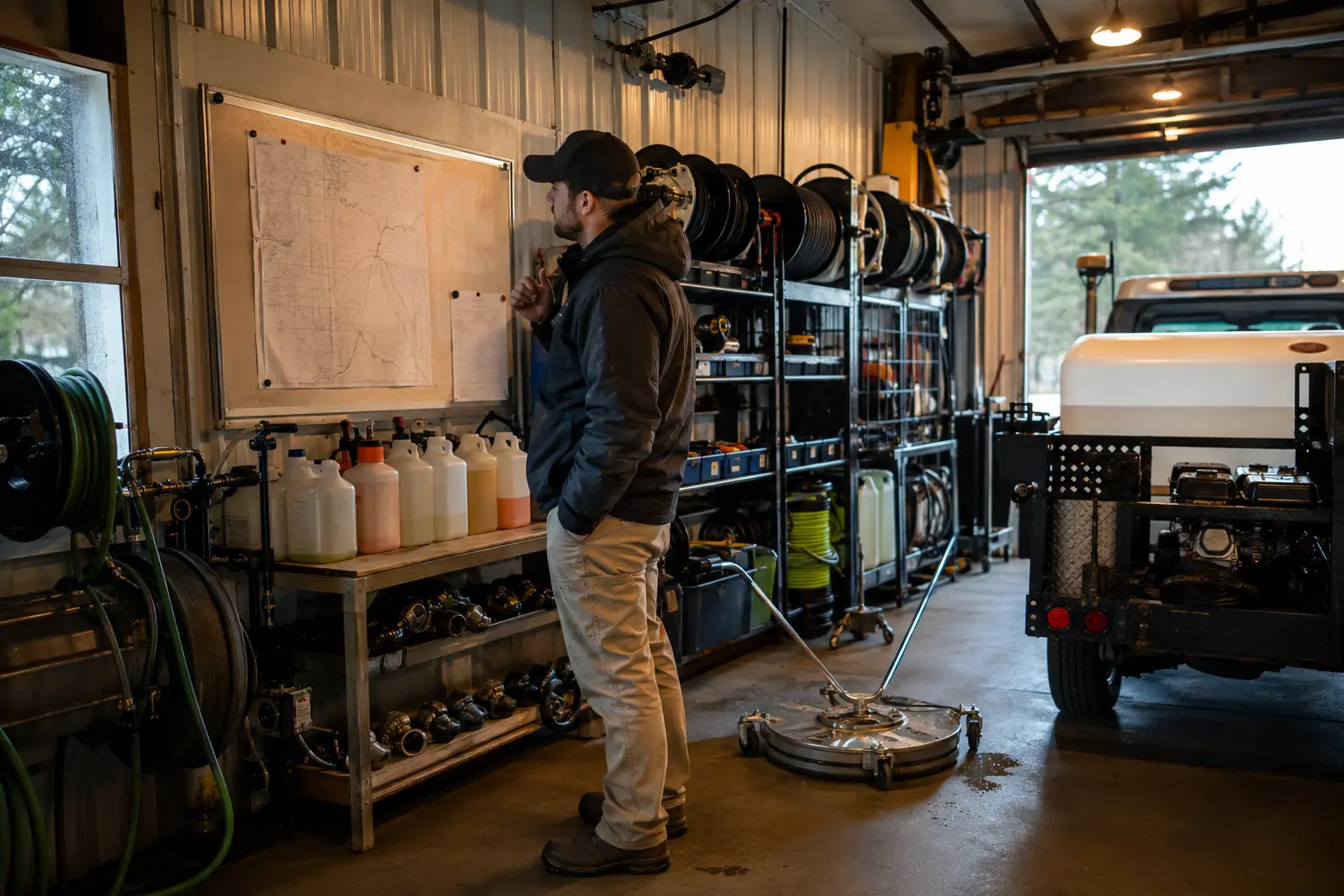
Verify entity registration, licensing or permits where required, insurance scope, chemical storage and transport, wastewater rules, PPE, equipment maintenance, contracts, payment workflow, and recordkeeping.
Measure scope, document conditions, identify exclusions, model labor and risk, state assumptions, and define change conditions. A quote should protect both the customer’s expectations and the operator’s margin.
Build a real Google Business Profile for the operating business, accurate citations, service evidence, customer reviews, useful local pages, referral relationships, and follow-up systems. Pressure-Washing.net itself does not claim a local service area.
Do not hire, finance larger equipment, or add service territory from revenue alone. Track contribution margin, callbacks, utilization, route density, lead source, close rate, cash timing, and owner workload.
Surface condition, finish, soil type, water supply, access, drainage, equipment condition, nozzle and flow, chemical compatibility, operator technique, and local requirements can all change the correct decision.
Verify the exact material, existing damage, manufacturer instructions, product labels, PPE, water and electrical hazards, runoff controls, a safe test area, and the limits of your training.
Stop when the material or coating is unknown or unstable, access is unsafe, runoff cannot be controlled, electrical or water-intrusion risk remains, or the test area shows damage or an unexpected reaction.
General guidance cannot account for every surface, product, site, or local requirement. Follow equipment manuals and chemical labels, use appropriate PPE, test first, control runoff, and hire qualified help when conditions exceed your training or safe access.