Homeowner equipment
Electric machines fit light, intermittent cleaning near reliable power and water. Consumer gas machines add mobility and output but also noise, fumes, maintenance, storage, and greater damage potential.
Choose equipment by required flow, working pressure, duty cycle, water supply, accessory compatibility, serviceability, and the jobs you will actually perform—not by peak PSI alone.
For cleaning speed, GPM is often the neglected specification. Confirm the pump’s continuous capability, engine pairing, inlet supply, hose losses, and accessory limits before purchasing.
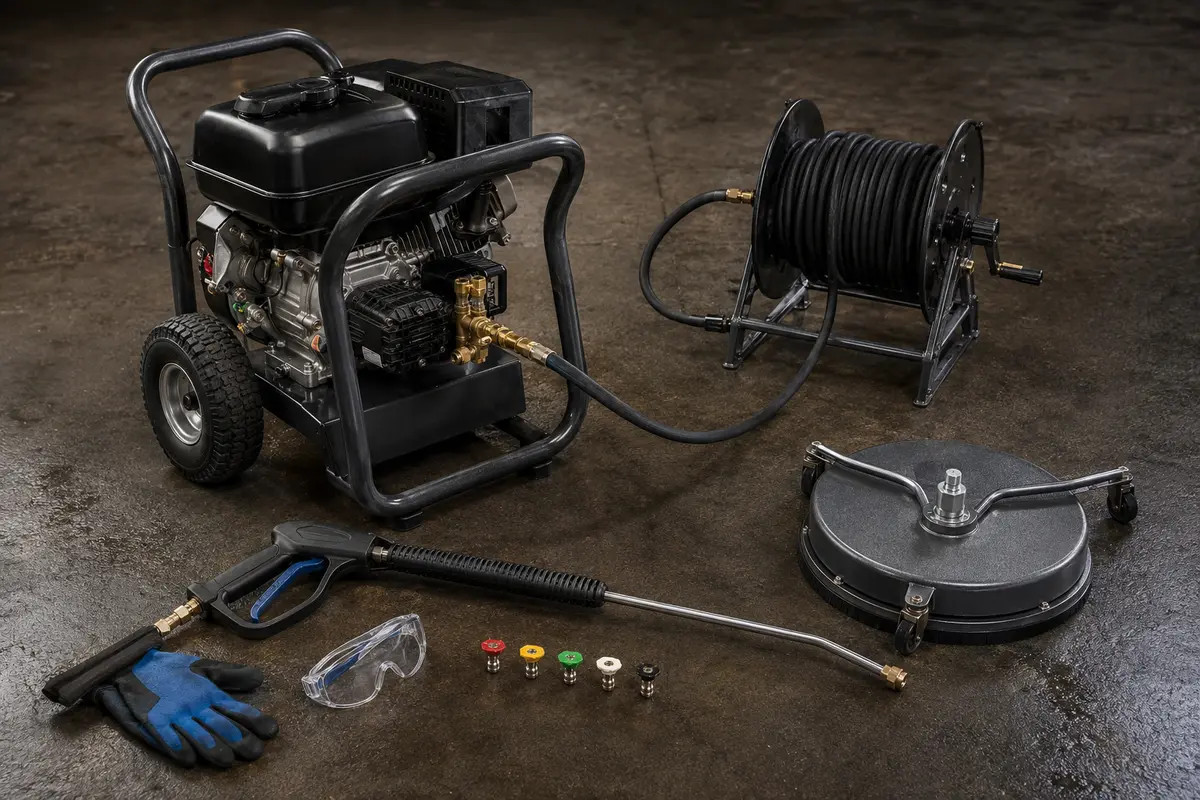
The strongest pressure washer is the machine that matches the buyer’s actual scope, water supply, duty cycle, maintenance ability, transport, accessories, service access, and contamination—not the largest advertised PSI number.
Open buyer-fit guide Homeowner buyer fitChoose an electric pressure washer for lighter, intermittent cleaning when convenient startup, compact storage, and lower maintenance matter more than high sustained flow.
Open buyer-fit guide Higher-output residential fitA gas pressure washer makes sense when mobility, stronger sustained output, and larger residential jobs justify fuel, engine maintenance, outdoor-only operation, noise, storage, and higher damage potential.
Open buyer-fit guide Professional equipment architectureA commercial pressure washer should be selected as a serviceable production system: pump, engine or motor, water supply, bypass, hose, reels, nozzles, surface cleaner, chemical delivery, transport, and repair plan must work together.
Open buyer-fit guide Accessory compatibilityMatch surface-cleaner diameter, swivel design, working-pressure rating, and bar nozzles to the machine’s actual GPM and target pressure. Diameter alone does not predict cleaning speed.
Open buyer-fit guideElectric machines fit light, intermittent cleaning near reliable power and water. Consumer gas machines add mobility and output but also noise, fumes, maintenance, storage, and greater damage potential.
Commercial buyers should evaluate duty cycle, rebuildability, parts availability, unloader design, pump speed, engine load, bypass management, frame access, hose capacity, and downtime cost.
Surface-cleaner size must match real flow; nozzle orifice must match GPM and target pressure; hoses, reels, guns, injectors, and fittings must meet working-pressure and chemical-compatibility requirements.
Occasional users without storage, maintenance ability, water supply, safe work practices, or a need for high output can create cost and risk without gaining useful productivity.
Surface condition, finish, soil type, water supply, access, drainage, equipment condition, nozzle and flow, chemical compatibility, operator technique, and local requirements can all change the correct decision.
Verify the exact material, existing damage, manufacturer instructions, product labels, PPE, water and electrical hazards, runoff controls, a safe test area, and the limits of your training.
Stop when the material or coating is unknown or unstable, access is unsafe, runoff cannot be controlled, electrical or water-intrusion risk remains, or the test area shows damage or an unexpected reaction.
General guidance cannot account for every surface, product, site, or local requirement. Follow equipment manuals and chemical labels, use appropriate PPE, test first, control runoff, and hire qualified help when conditions exceed your training or safe access.