Home/guides /When Soft Washing Is Safer Than High Pressure
Risk-based method
When Soft Washing Is Safer Than High Pressure
Soft washing is generally safer when cleaning depends on treating biological growth and the surface or building envelope could be damaged by concentrated mechanical force.
QUICK VERDICT
Consider low-pressure chemical cleaning for many roof and siding conditions, delicate coatings, and organic soil—but only with correct chemistry, PPE, plant and metal protection, runoff control, and rinsing.
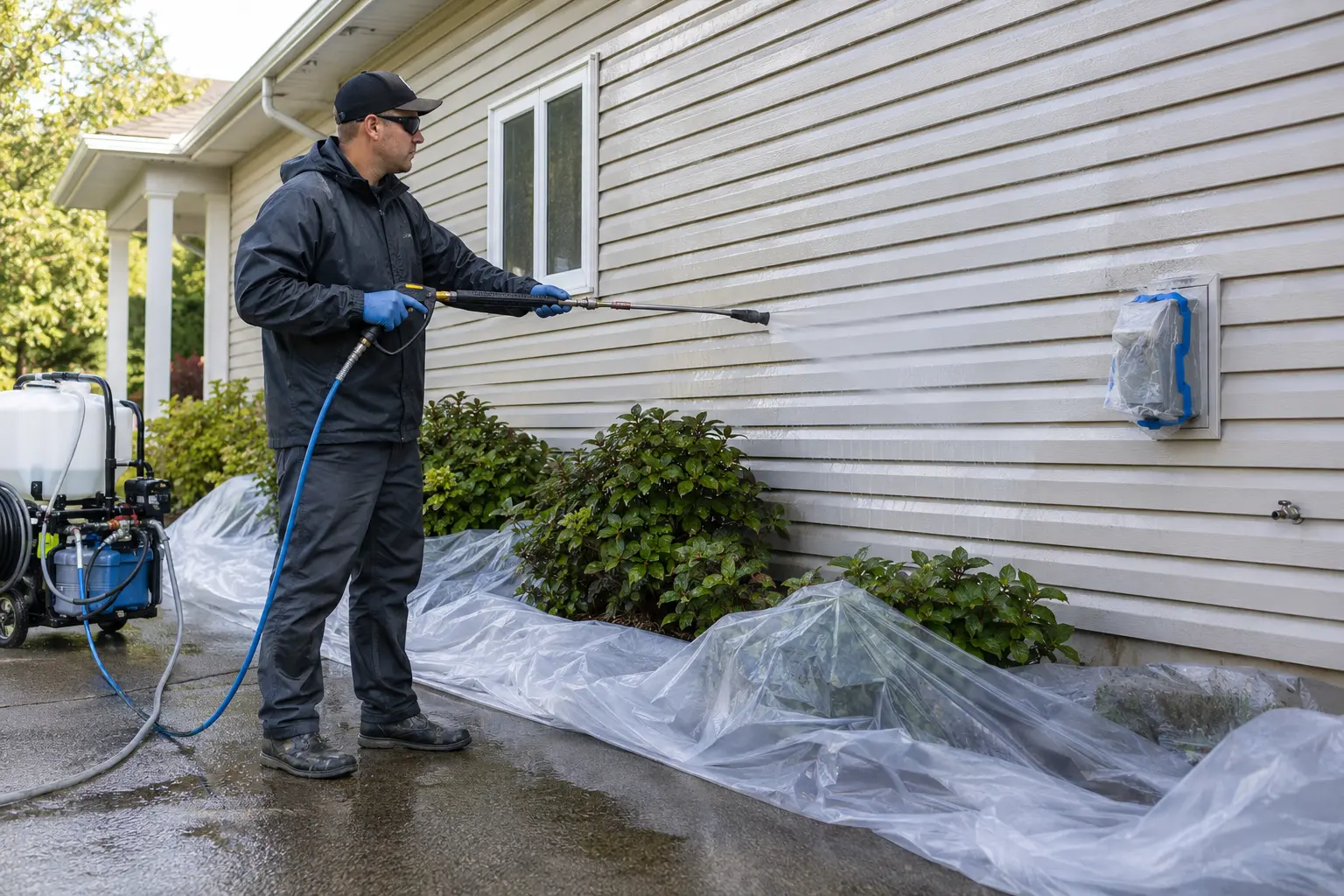
Low pressure, compatible chemistry, plant protection, and controlled rinsing are one connected process.01
Why low pressure helps
Reduced mechanical impact lowers the chance of cutting wood, forcing water behind siding, removing roof granules or finish, and creating wand marks on oxidation. The method changes the cleaning mechanism from impact toward compatible chemistry, dwell, agitation where permitted, and controlled rinsing.
02
Surface-and-soil decision gate
Soft washing is most defensible when the contamination is chemically treatable and the substrate is mechanically vulnerable. It is not automatically the answer for grease, mineral deposits, failed coatings, unstable masonry, hazardous residues, or soils requiring collection and specialized disposal.
03
Chemistry adds different risks
Low pressure does not mean low risk. Wrong concentration, incompatible materials, poor mixing, overspray, dried product, plant exposure, metal oxidation, glass spotting, and uncontrolled runoff can cause harm beyond the target surface.
04
Building-envelope control
Map laps, vents, weep paths, penetrations, electrical fixtures, deteriorated caulk, open windows, attic intake, and drainage before application. Use a rinse direction and volume that do not move treatment or water behind the cladding or roofing system.
05
Verification steps
Identify the substrate and soil, read labels and safety data, protect and pre-wet as appropriate, test, control dwell, prevent drying, rinse, and inspect metals, plants, glass, lower surfaces, and drainage. Reinspect after drying for streaks, oxidation marks, residue, or missed growth.
06
Professional boundary
Roof access, steep terrain, sensitive landscaping, complex drainage, unknown materials, concentrated chemicals, public exposure, or runoff near stormwater systems justify trained and insured professional involvement.
Frequently asked questions
Questions that change the decision
What conditions can change the answer on When Soft Washing Is Safer Than High Pressure?
Surface condition, finish, soil type, water supply, access, drainage, equipment condition, nozzle and flow, chemical compatibility, operator technique, and local requirements can all change the correct decision.
What should I verify before using this risk-based method guidance?
Verify the exact material, existing damage, manufacturer instructions, product labels, PPE, water and electrical hazards, runoff controls, a safe test area, and the limits of your training.
When should I stop and hire a professional?
Stop when the material or coating is unknown or unstable, access is unsafe, runoff cannot be controlled, electrical or water-intrusion risk remains, or the test area shows damage or an unexpected reaction.
General guidance cannot account for every surface, product, site, or local requirement. Follow equipment manuals and chemical labels, use appropriate PPE, test first, control runoff, and hire qualified help when conditions exceed your training or safe access.